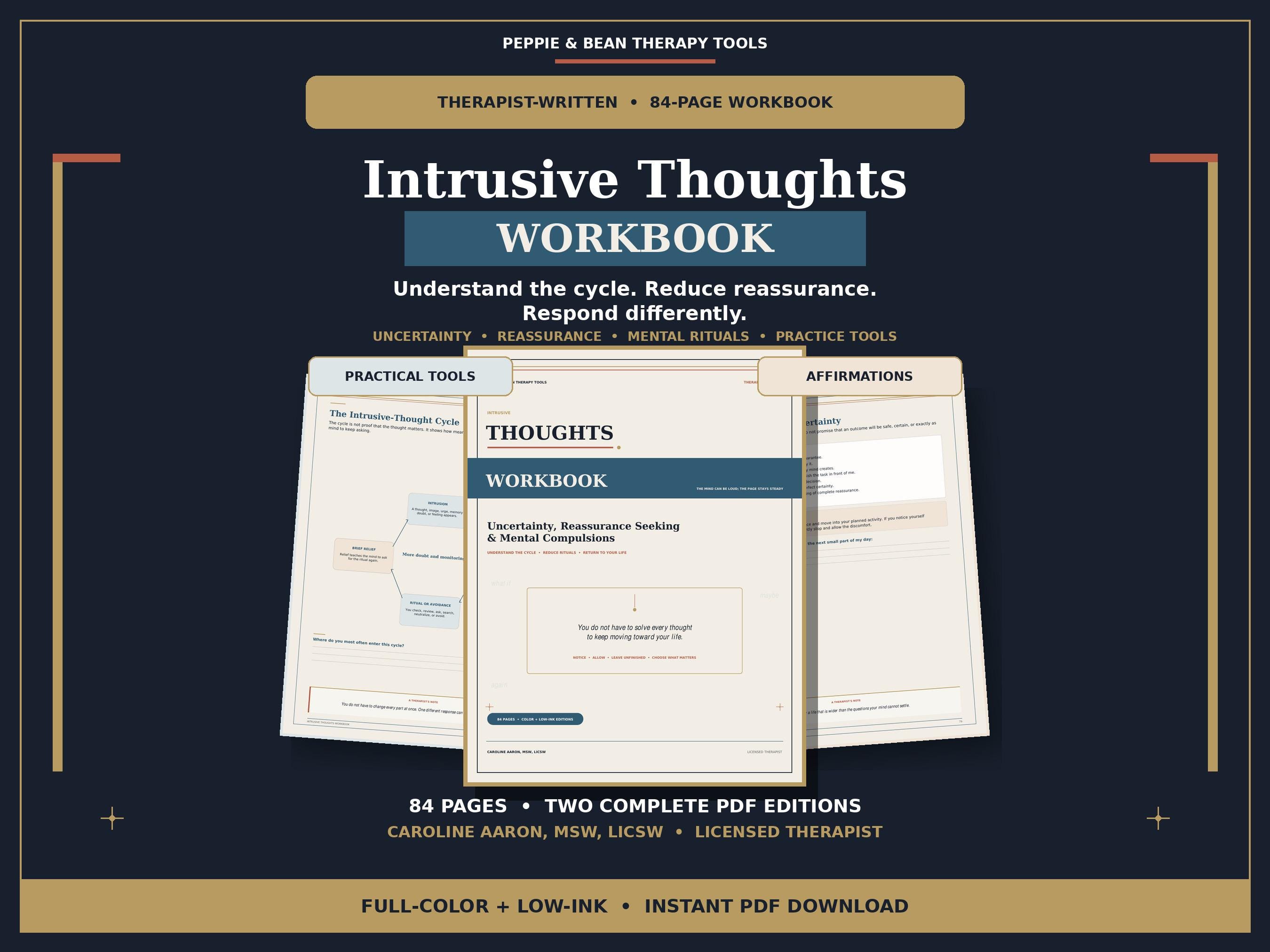
Intrusive Thoughts Workbook: Uncertainty, Reassurance Seeking, Mental Compulsions (PDF Download)
$7.99
When your mind keeps asking, “But what if?” more thinking rarely brings
the lasting relief it promises.
This therapist-written intrusive thoughts workbook helps you recognize
reassurance seeking and mental compulsions, make room for uncertainty,
and practice a different response—one steady step at a time.
Intrusive thoughts can arrive as words, images, urges, memories, or
uncomfortable sensations. You may replay a conversation, check your
feelings, search online, ask someone for reassurance, review your
memory, or mentally argue with a thought until it seems “resolved.” The
relief may be real—but often it does not last.
I created this workbook to help you understand that cycle without shame.
Written by Caroline Aaron, MSW, LICSW, the Intrusive Thoughts Workbook:
Uncertainty, Reassurance Seeking & Mental Compulsions uses clear,
everyday language to explain why unwanted thoughts can feel so urgent
and why repeated attempts to become completely certain may keep the
doubt going.
This is not a workbook about forcing thoughts away, proving that a fear
is impossible, or controlling every thought that enters your mind.
Instead, it offers compassionate education, guided reflection, and
ERP-informed practice for responding with less checking, less debate,
and more freedom to return to the life in front of you.
What You Will Explore
Understand intrusive thoughts
- Learn how intrusive thoughts may show up as thoughts, images, urges,
memories, or sensations
- Explore why some thoughts feel unusually urgent or “sticky”
- Separate having a thought from making a choice
- Understand thought-action fusion, inflated responsibility, shame,
and the need to feel certain
Recognize the cycle
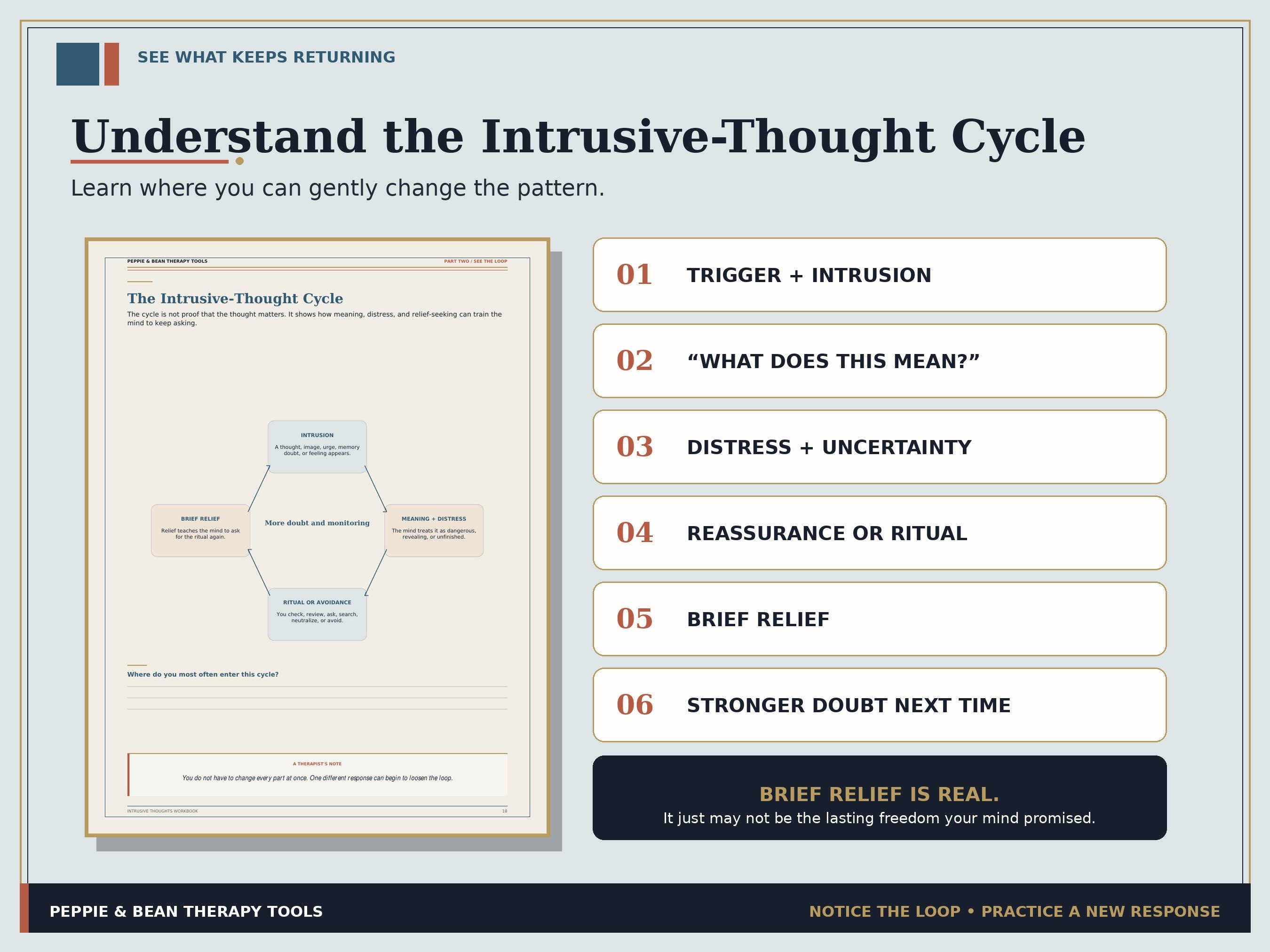
- Map the pattern from trigger and intrusive thought to distress,
compulsion, brief relief, and renewed doubt
- Notice visible compulsions, hidden mental compulsions, avoidance,
neutralizing, and confessing
- Learn the difference between helpful reflection and rumination that
keeps searching for a final answer
- Identify your own short-term relief and longer-term cost
Build tolerance for uncertainty
- Explore why certainty can feel essential even when it is impossible
to guarantee
- Practice “maybe, maybe not” and leaving a question unfinished
- Make good-enough decisions without waiting to feel completely sure
- Create a personal uncertainty ladder and plan small, ordinary
practice steps
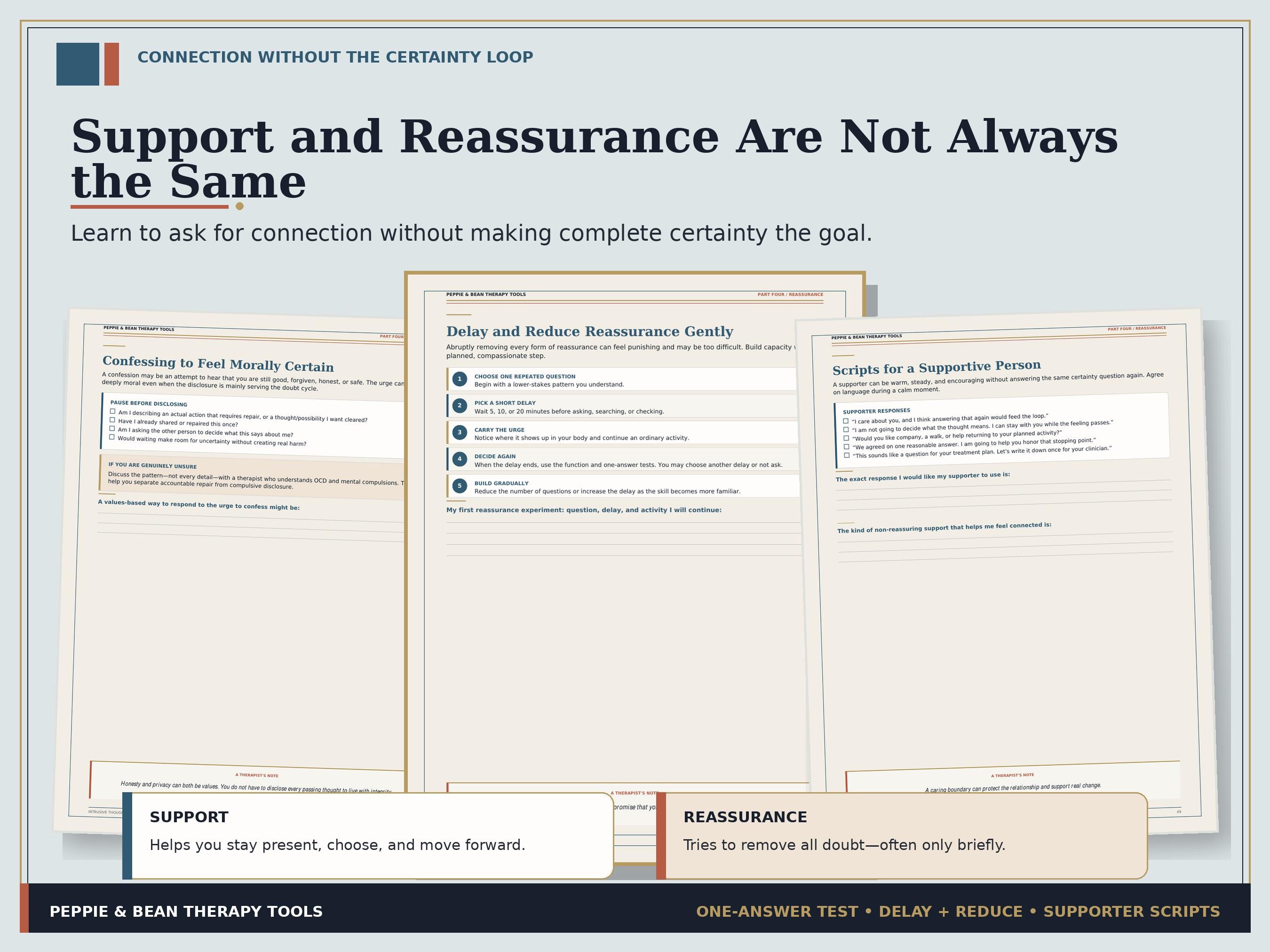
Understand reassurance seeking
- Recognize reassurance from other people, internet searches,
rereading, comparing, checking, confessing, and internal
self-reassurance
- Learn how support and reassurance can serve different purposes
- Use the “one-answer” test to notice when a question has become part
of a loop
- Try gentle delay-and-reduce experiments
- Use therapist-written scripts for reassurance urges and supportive
conversations
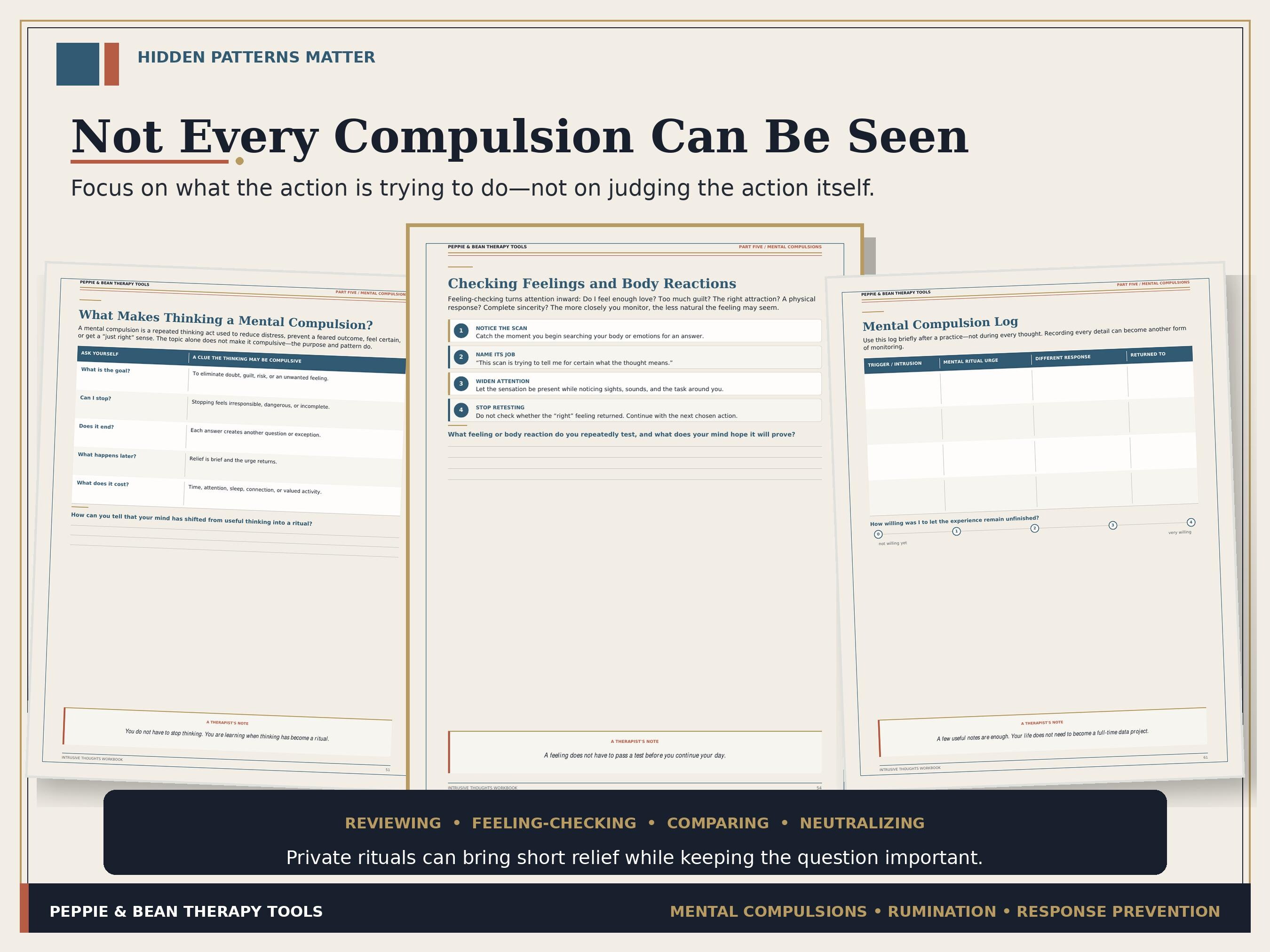
Spot hidden mental compulsions
- Reviewing memories and conversations
- Analyzing what a thought “really means”
- Checking feelings, intentions, body sensations, or attraction
- Comparing, testing, proving, replacing, or neutralizing thoughts
- Repeating words, prayers, counts, or phrases when the goal is to
remove doubt or distress
- Suppressing thoughts or mentally avoiding a feared possibility
The workbook focuses on the purpose of a behavior—not on judging the
behavior itself.
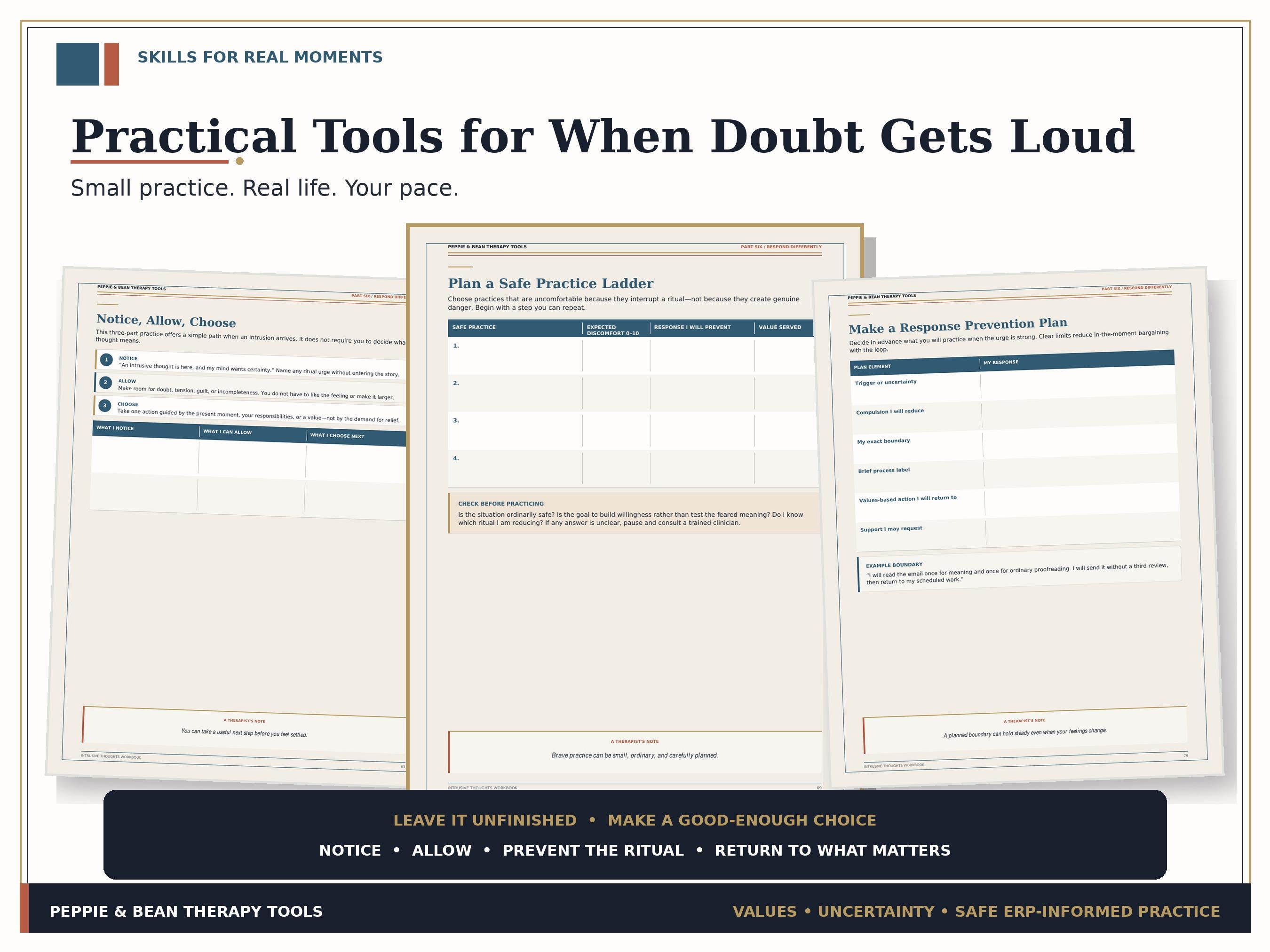
Practice a different response
- Use a simple Notice–Allow–Choose approach
- Practice defusion, willingness, and values-based next steps
- Try grounding that supports presence rather than escape
- Create safe, ERP-informed practice and response-prevention plans
- Debrief practice without grading yourself or checking whether you
“did it perfectly”
- Build a personal response plan for future difficult moments
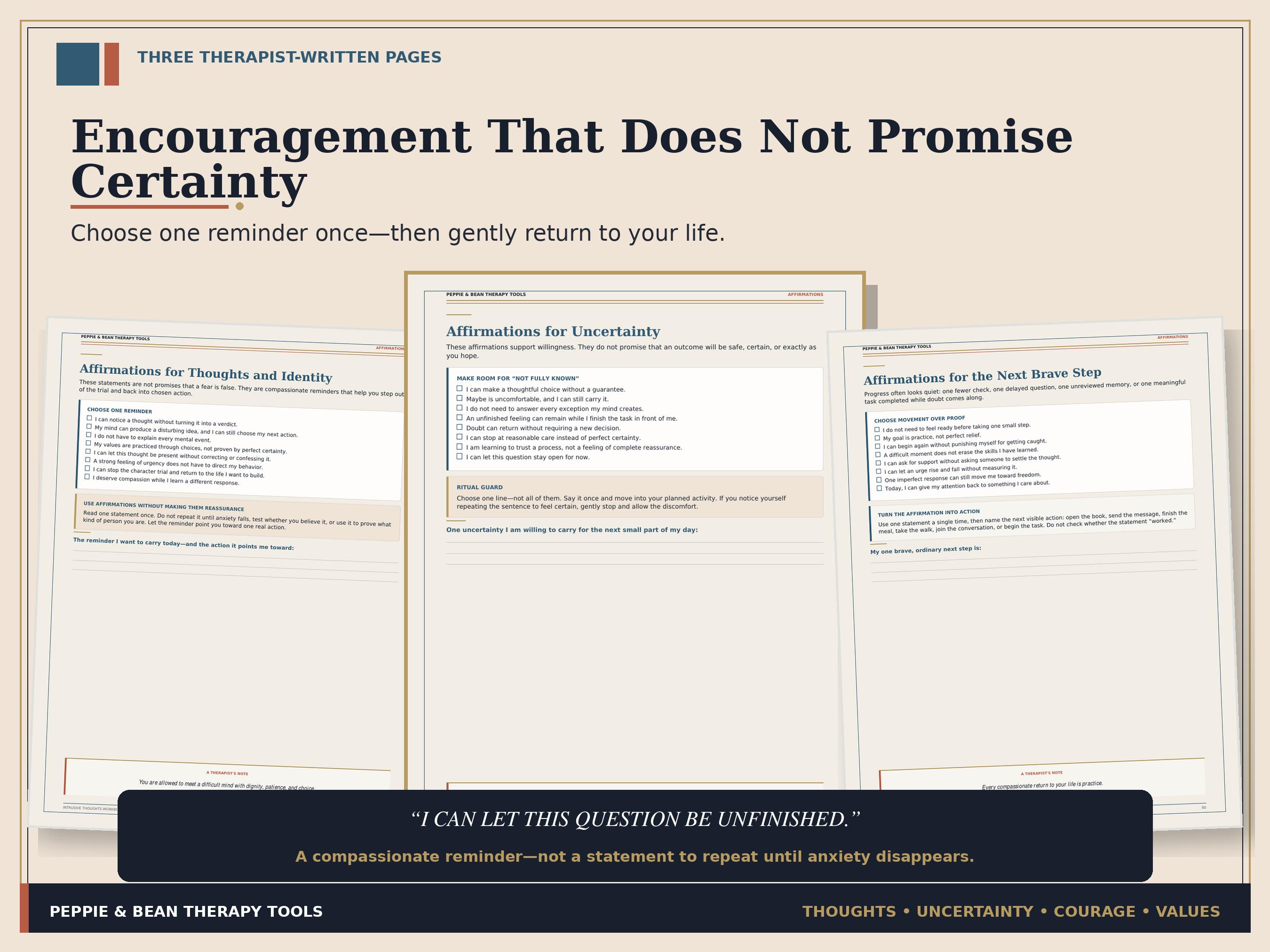
Therapist-Written Affirmation Section
Three dedicated affirmation pages offer grounded reminders for moments
when doubt feels loud. These statements do not promise certainty or tell
you that nothing bad will happen. They support a different relationship
with thoughts:
- “A thought can feel important without needing an answer.”
- “I can let this question be unfinished.”
- “I can choose my next step without feeling completely sure.”
- “Discomfort is not a command.”
- “I can return to what matters, one moment at a time.”
Because even a helpful statement can become part of a reassurance
ritual, the workbook encourages you to choose one reminder once, then
gently return to the next meaningful part of your day. You do not have
to repeat it until anxiety disappears.
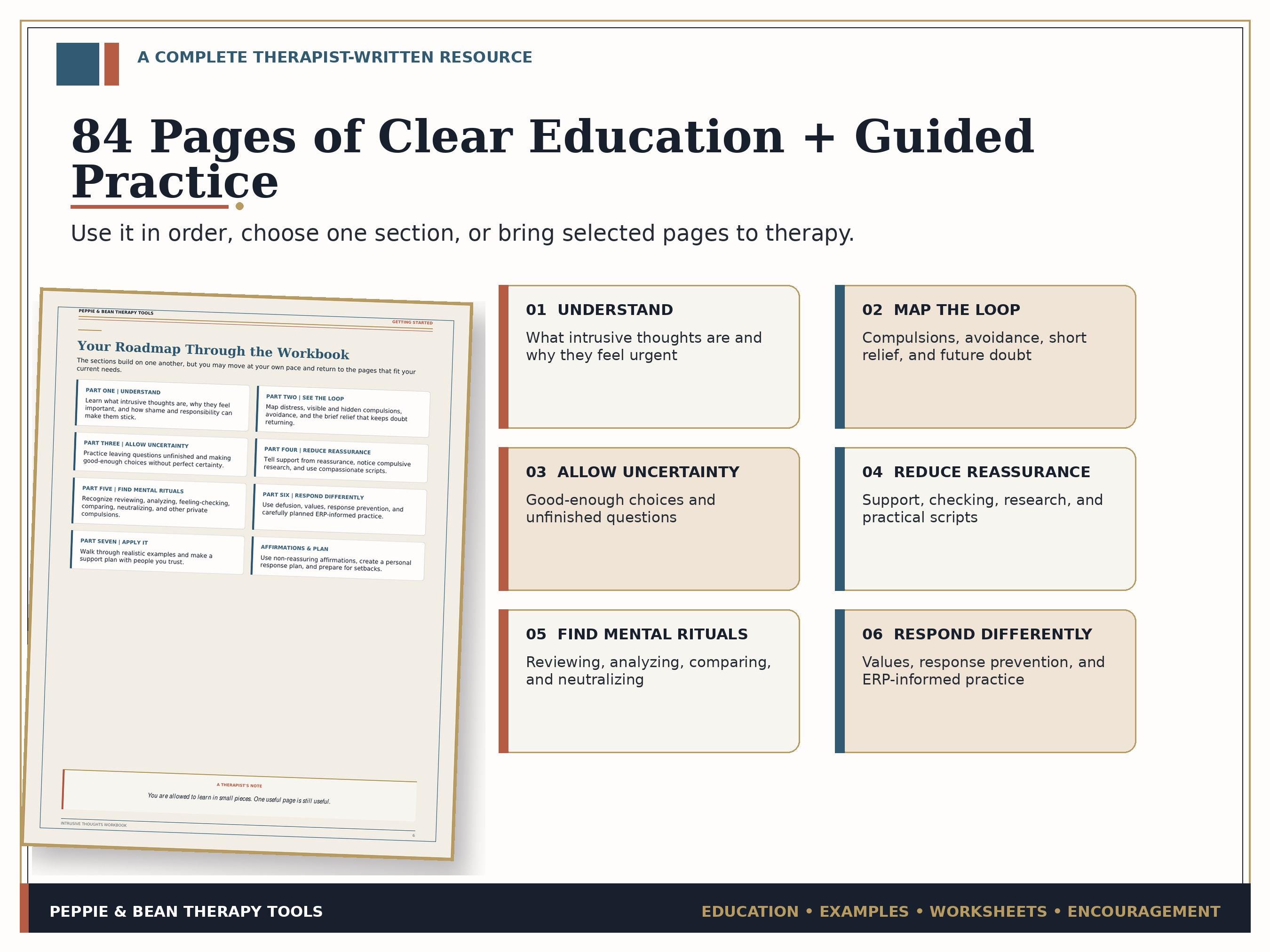
Inside the 84-Page Workbook
This is an 84-page total workbook, including the cover, use and safety
guidance, educational pages, guided exercises, examples, reflection
pages, affirmation section, sources, and closing letter.
Named tools and pages include:
- Intrusive-Thought Cycle Map
- Personal Pattern Snapshot
- Relief Now / Cost Later reflection
- Rumination Versus Reflection guide
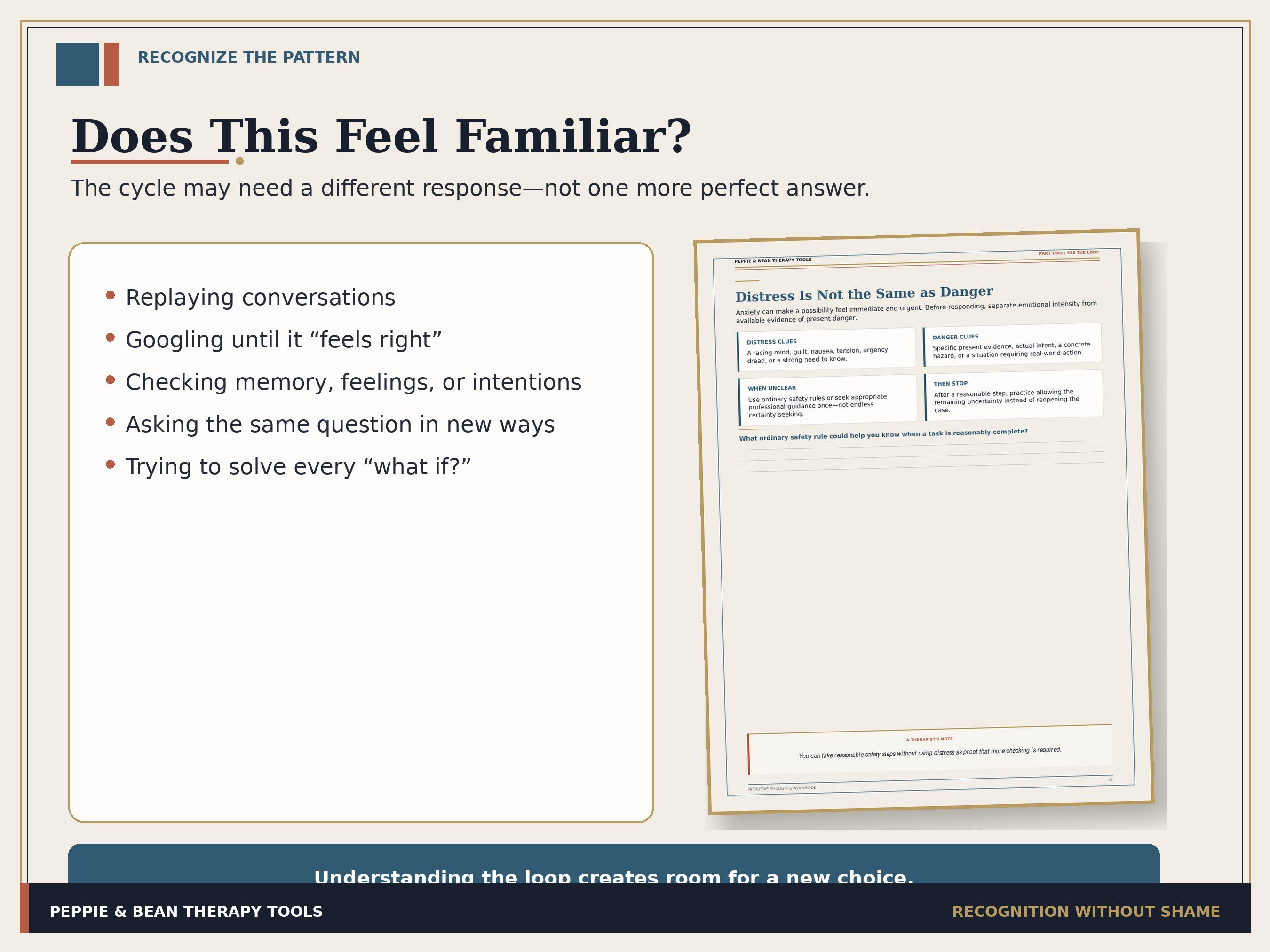
- Distress Versus Danger check
- Everyday Uncertainty practice
- Good-Enough Decision guide
- Uncertainty Ladder
- Reassurance Cycle
- Support Versus Reassurance comparison
- One-Answer Test
- Delay-and-Reduce Experiment
- Reassurance-Urge Scripts
- Supporter Scripts
- Mental Compulsion Log
- Notice–Allow–Choose practice
- Defusion and Willingness tools
- Values-Based Next Step
- Safe ERP-Informed Practice Ladder
- Response-Prevention Plan
- Practice Debrief Without Grading
- Real-life examples for common intrusive-thought themes
- Three pages of therapist-written affirmations
- Personal Response Plan
- Setback and Additional-Support guidance
This Workbook May Be a Helpful Fit If You
- Feel caught in repeated “what if?” questions
- Replay conversations or review memories for certainty
- Check your feelings, intentions, body, or reactions
- Ask for reassurance in slightly different ways
- Search online or use research to try to settle a fear
- Mentally argue, prove, compare, confess, test, or neutralize
- Want to understand rumination and hidden mental compulsions
- Prefer warm, plain language instead of heavily clinical wording
- Want an intrusive thoughts workbook or OCD workbook for adults to
use independently or alongside therapy
- Are looking for gentle, ERP-informed education without promises to
eliminate thoughts
You do not need a diagnosis to learn from the educational material. This
workbook also cannot tell you whether you have OCD or any other
condition.
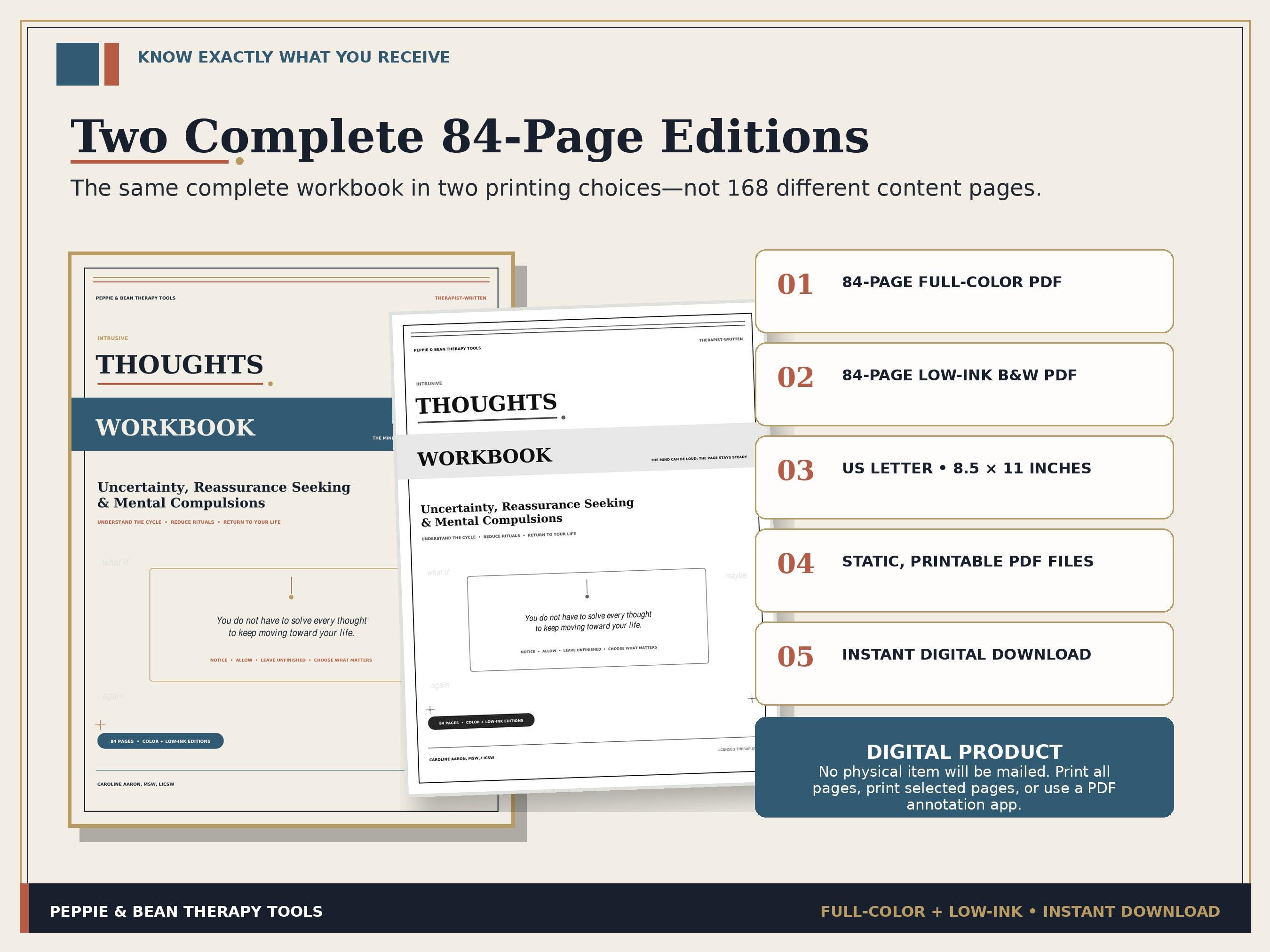
Exactly What You Will Receive
You will receive two complete downloadable PDF files:
1. One 84-page full-color workbook
2. One 84-page low-ink black-and-white workbook
Both files contain the same complete workbook in two visual editions.
They are printing choices—not 168 different content pages.
- US Letter size: 8.5 × 11 inches
- Static, printable PDF files
- Instant digital download
- No physical item will be mailed
You may print the full workbook, print only the pages you want, or write
on the PDFs with a compatible annotation app. The files are not editable
or fillable forms. Print results and colors may vary with your monitor,
printer, ink, paper, and print settings.
Use It Without Turning It Into Another Rule
You do not have to complete the workbook in order. You may begin with
the section that feels most useful, skip a prompt, leave a response
unfinished, or bring selected pages into therapy.
Try not to use a page to prove that you are safe, good, certain, or
“finished” with a thought. The goal is not a perfect answer. The goal is
to notice the process, practice allowing some uncertainty, and choose
the next step that matters to you.
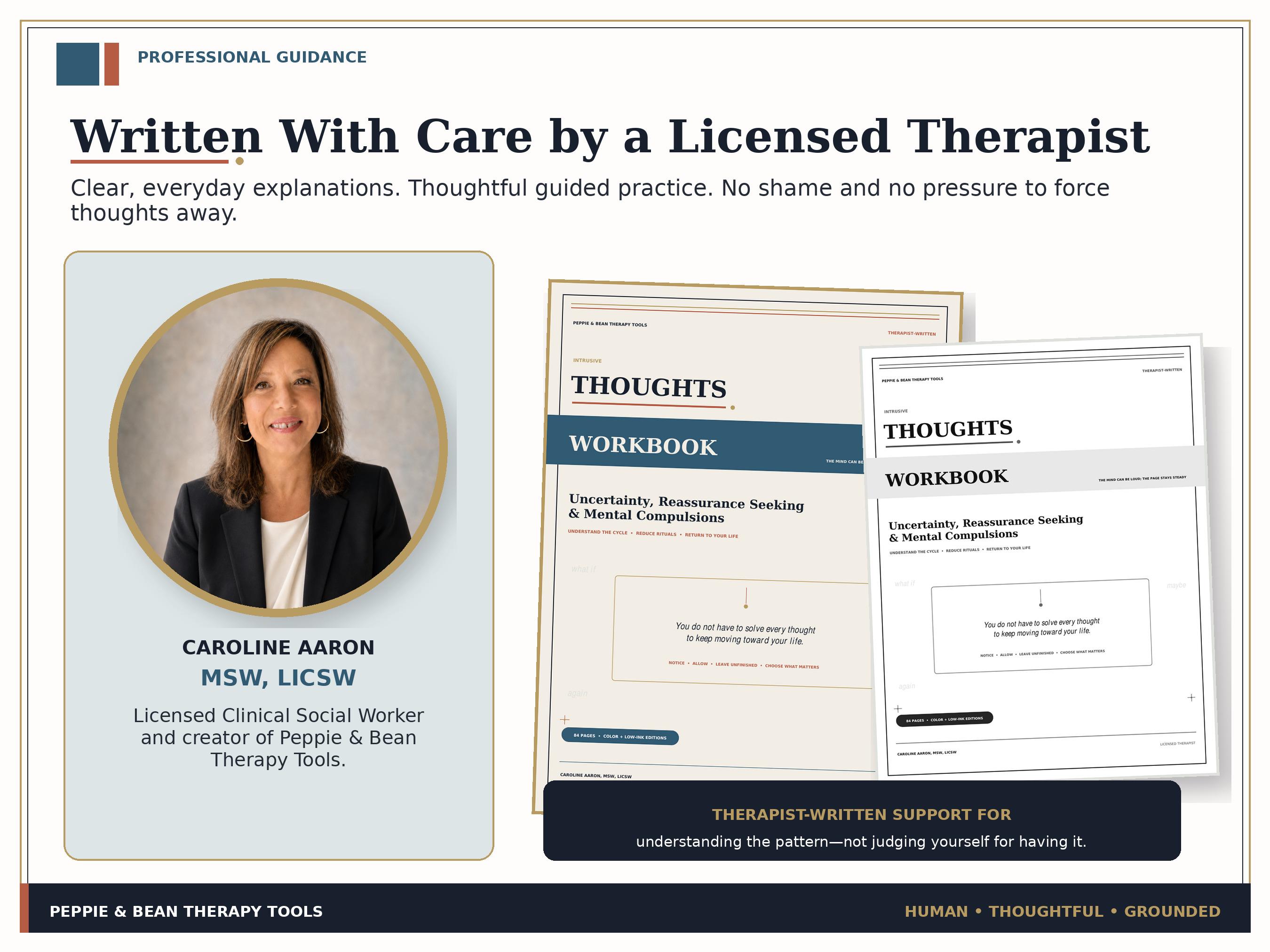
Created by a Licensed Therapist
I am Caroline Aaron, MSW, LICSW. I wrote this workbook in the same warm,
straightforward way I would explain these patterns in a therapy room:
with compassion for how convincing the fear can feel and respect for how
hard it is to step away from a familiar relief strategy.
You are not failing because your mind wants one more answer. A pattern
can make sense and still be changed gently. You can practice meeting
uncertainty with less debate and taking one meaningful step before you
feel completely sure.
Important Educational and Clinical Disclaimer
This workbook provides general education, guided reflection, and skills
practice. It is not therapy, medical advice, diagnosis, crisis care, or
a substitute for individualized care from a qualified mental-health or
medical professional. Purchasing or using it does not create a
therapist-client relationship with Caroline Aaron or Sylacauga
Counseling.
ERP-informed exercises in this workbook are educational and should
remain safe, legal, ordinary, and consistent with consent and
appropriate medical care. Do not create an exercise that involves actual
danger, illegal behavior, violating another person’s consent, stopping
needed medication, ignoring medical guidance, or neglecting a genuine
safety concern. A clinician trained in OCD and ERP can help you adapt
practice when symptoms are severe, complex, trauma-related, or difficult
to distinguish from a real-world concern.
Unwanted intrusive thoughts are not the same as intention. However, if
you have an intention or plan to harm yourself or someone else, feel
unable to keep yourself or another person safe, hear commands, or are
losing touch with reality, seek urgent in-person help or contact local
emergency or crisis services.
The files may not be shared, resold, posted publicly, rebranded, altered
for resale, or included in another product.
You do not have to solve every thought before you are allowed to return
to your life.
Digital downloads
Your files will be available to download once payment is confirmed.
0 items in your cart