Adult Social Anxiety Workbook: CBT Tools for Judgment, Overthinking (Digital Download)
$7.99
Stop replaying every interaction. Start feeling safer being seen.
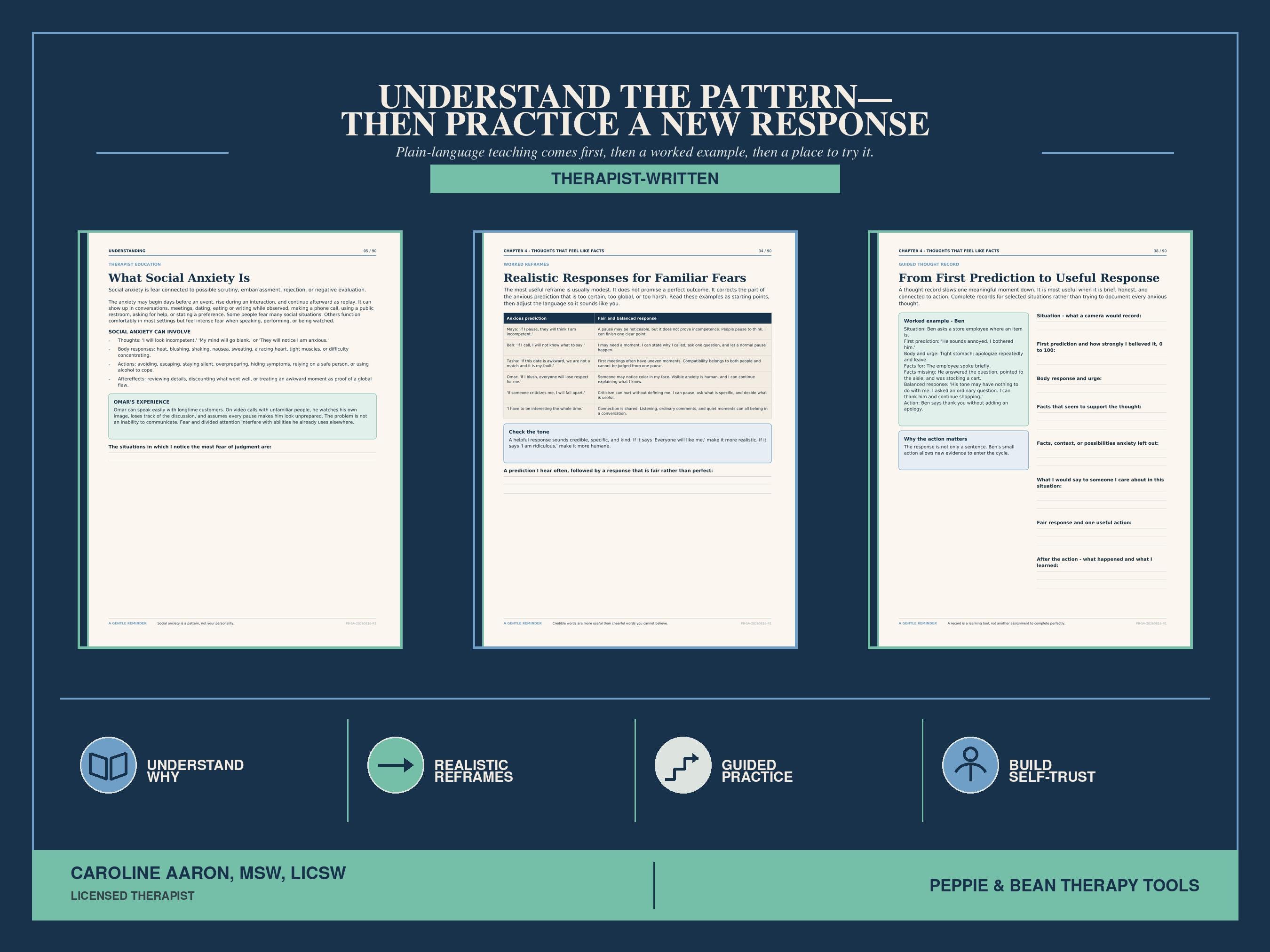
Do you rehearse what you are going to say before a conversation—then replay everything afterward?
Maybe you worry that people are judging your face, voice, pauses, body language, or words. You may avoid gatherings, stay quiet in meetings, overprepare for phone calls, depend on a “safe” person, cancel plans, or leave an interaction wondering whether you said something wrong.
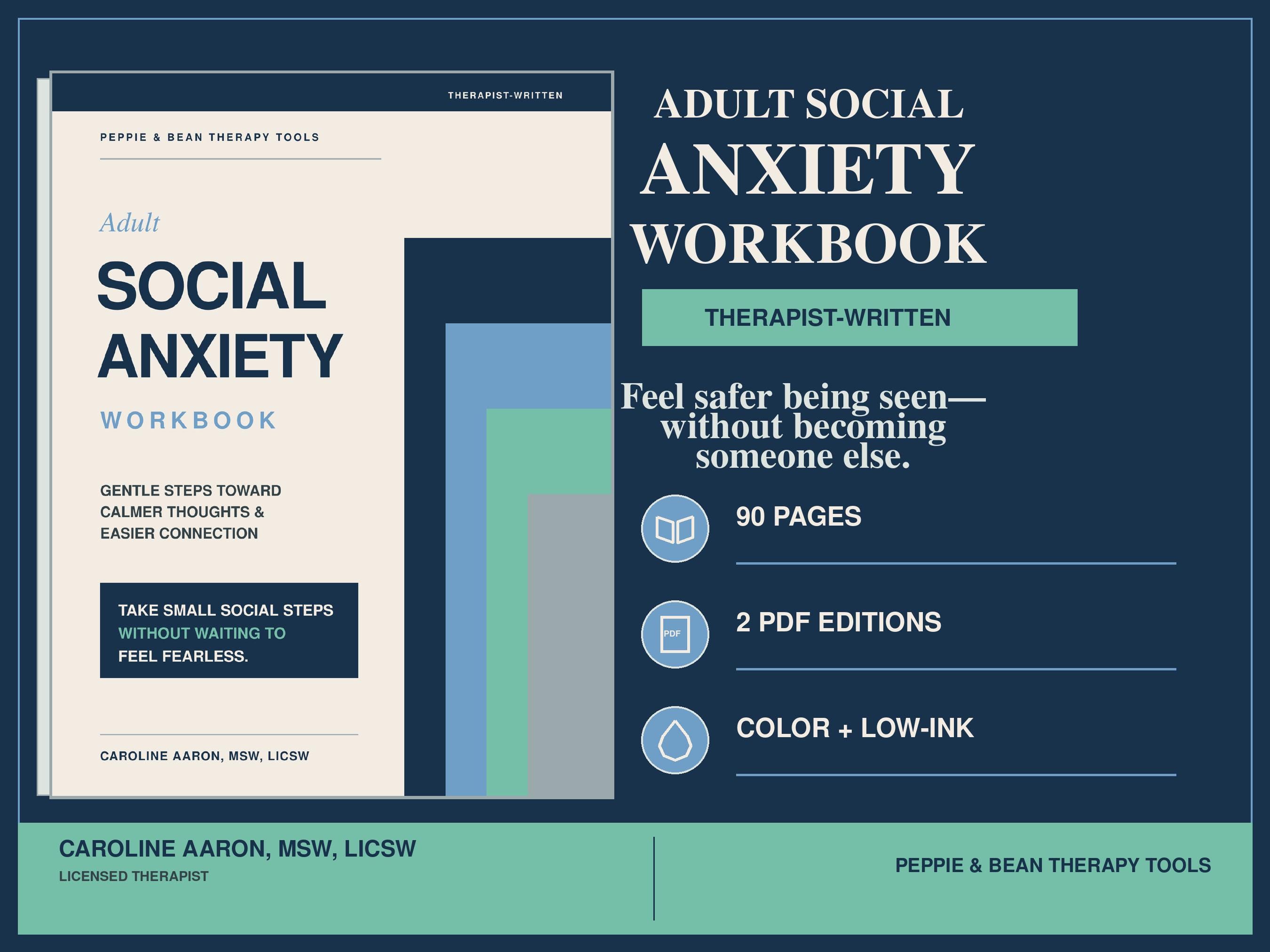
The Adult Social Anxiety Workbook is a therapist-written, 90-page book + workbook created to help adults understand these patterns and practice a different way of responding.
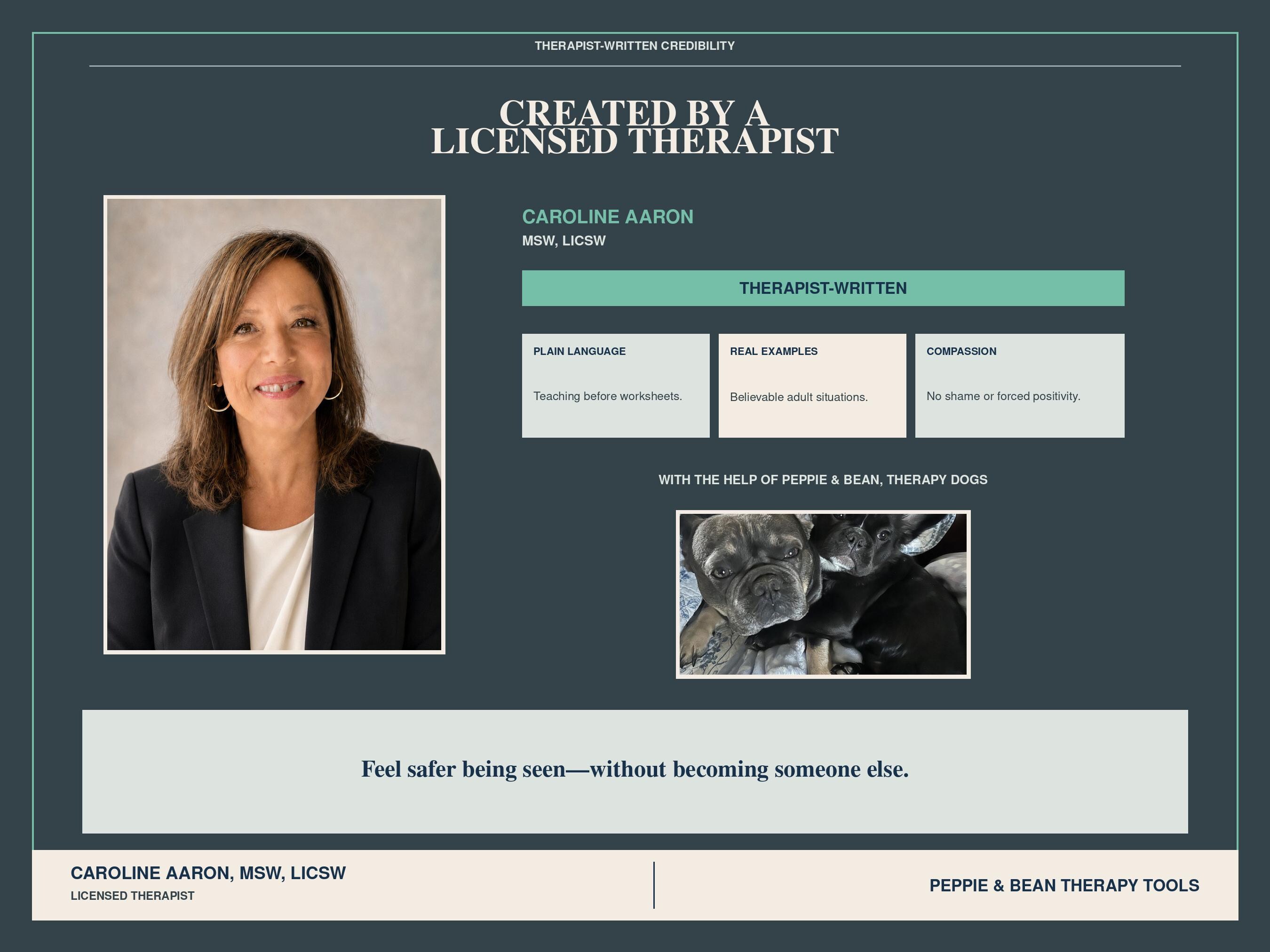
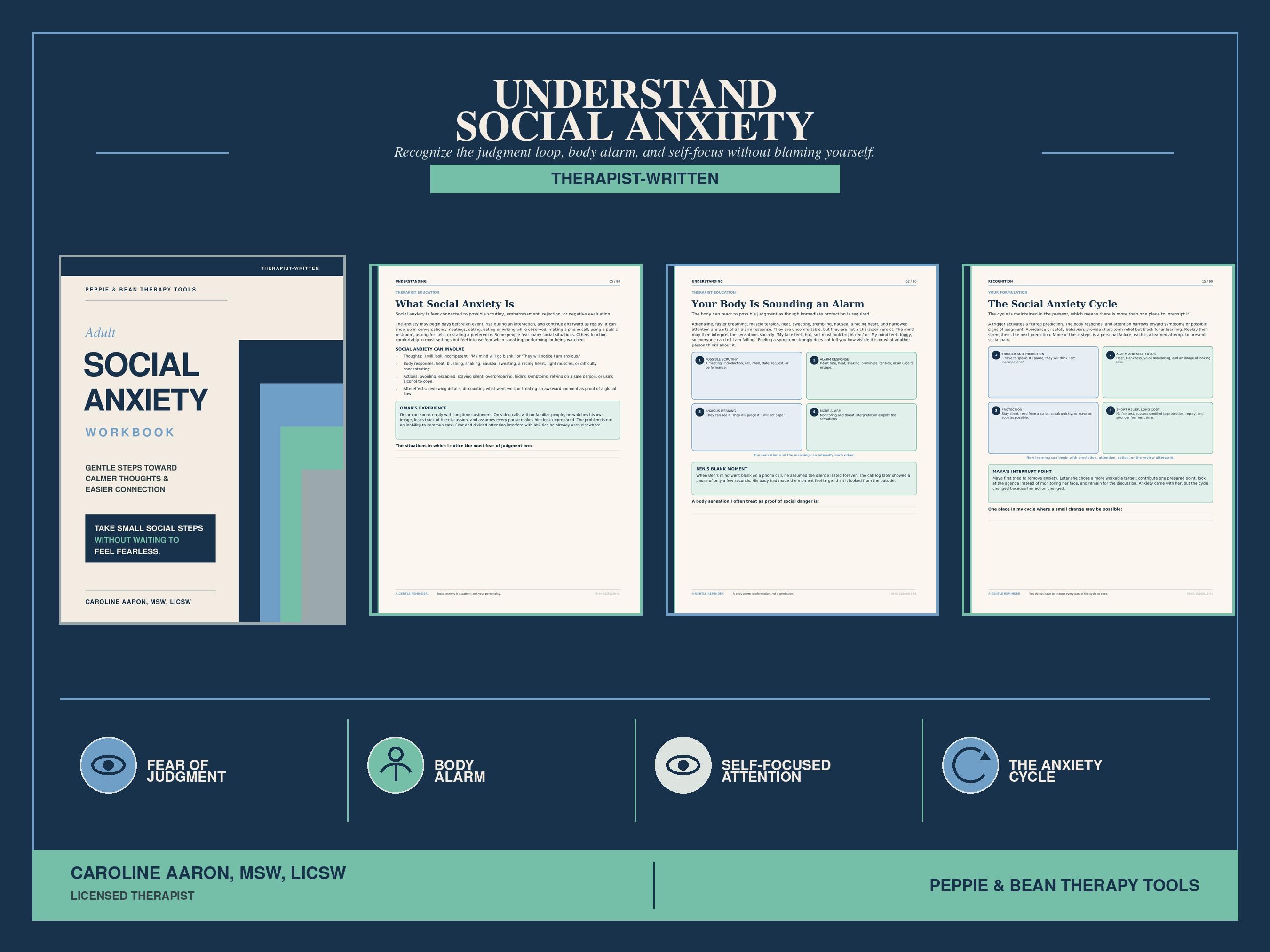
Created by Caroline Aaron, MSW, LICSW, this workbook combines warm, plain-language psychoeducation with CBT-informed tools, realistic fictional examples, diagrams, reflection, guided exercises, and gradual real-life practice.
The goal is not to turn you into an extrovert.
The goal is to help you participate more freely, build connection without feeling like you have to perform, and stop allowing anxiety to make every social decision for you.
WHAT YOU WILL EXPLORE
Inside the workbook, you’ll learn about:
* The social anxiety cycle and why it can keep repeating
* Fear of judgment and rejection
* Anticipatory anxiety before social situations
* Rehearsing conversations before they happen
* Body alarms and self-consciousness
* Self-focused attention and constantly monitoring yourself
* Anxious mental images of how you think you appear to others
* Avoidance and escape
* Safety behaviors that provide short-term relief but can keep anxiety going
* Post-conversation replay and overthinking
* How to separate observable facts from anxious predictions
* CBT-informed prediction testing
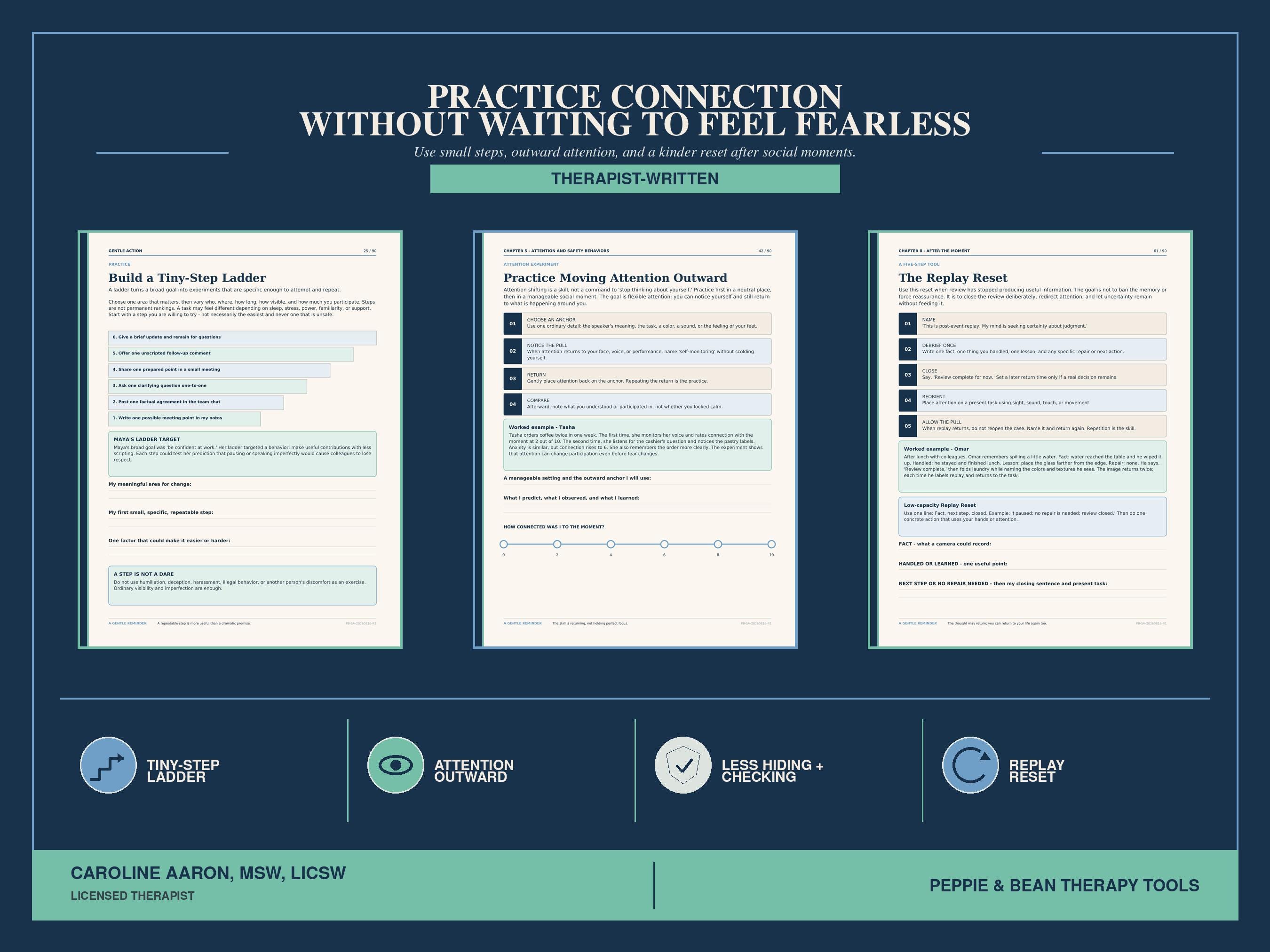
* Gradual, realistic social practice
* Practical communication strategies for everyday adult life
* Recovery after awkward or difficult interactions
* Support for low-capacity and especially anxious days
* Building a personal social-anxiety plan you can return to
PRACTICAL SKILLS — NOT JUST JOURNAL PROMPTS
This workbook teaches the skill before asking you to use it.
You’ll practice ways to:
SEE THE PATTERN
Recognize what happens before, during, and after a social interaction.
SHIFT ATTENTION
Move some attention away from monitoring yourself and toward the person, conversation, or task in front of you.
LOOSEN SAFETY BEHAVIORS
Notice habits such as over-rehearsing, hiding, excessive preparation, avoiding eye contact, depending on another person, or escaping early.
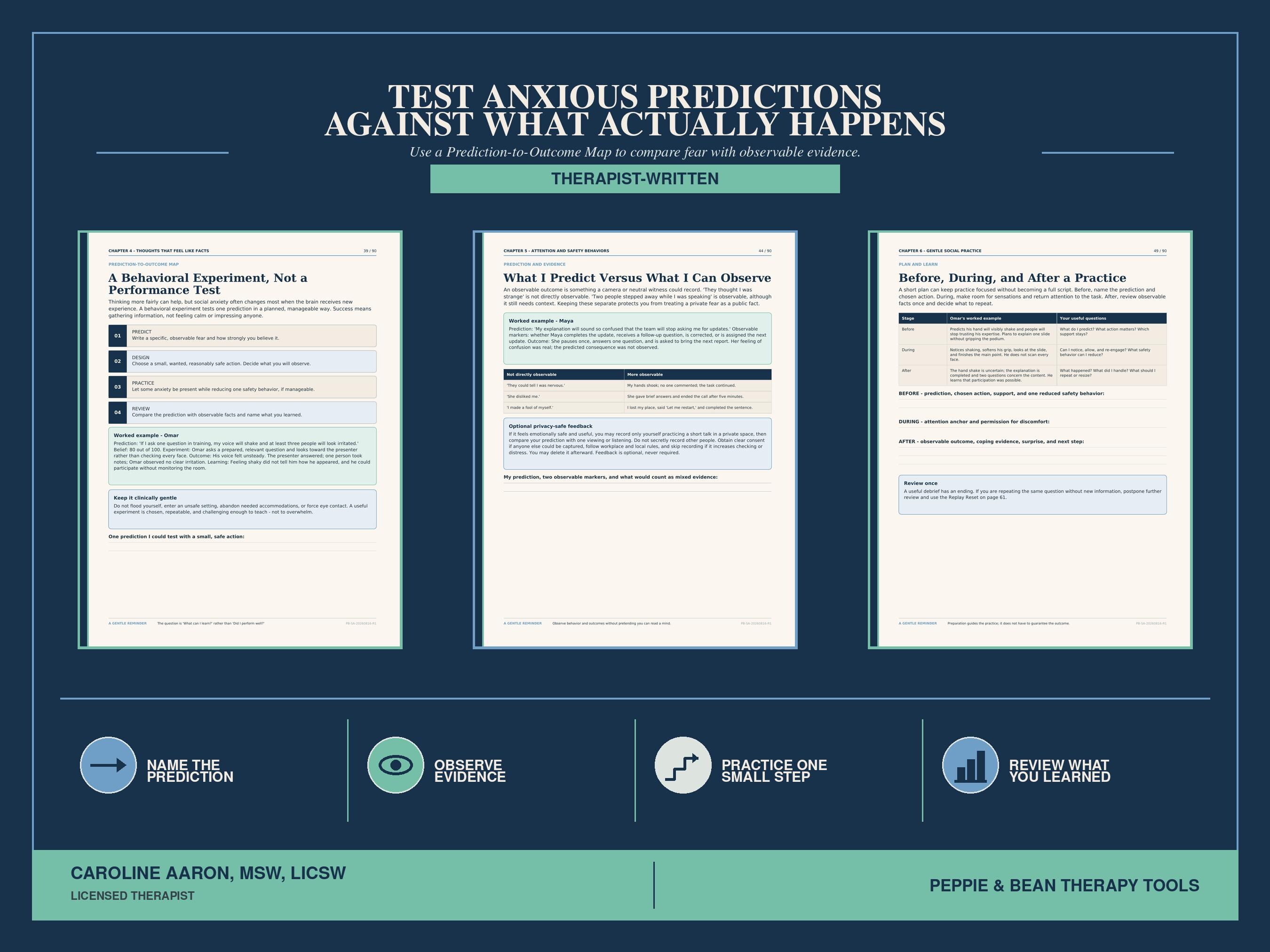
TEST A PREDICTION
Use the Prediction-to-Outcome Map to compare what anxiety predicted with what actually happened.
REPLAY LESS
Review observable facts and useful learning without turning every interaction into another trial of your worth.
SIGNATURE TOOL: THE PREDICTION-TO-OUTCOME MAP
Social anxiety often makes predictions feel like facts:
“They’ll think I’m awkward.”
“I’ll embarrass myself.”
“They’ll notice I’m nervous.”
“I won’t know what to say.”
The Prediction-to-Outcome Map helps you slow that process down.
You’ll learn to:
1. Identify the anxious prediction
2. Design one manageable practice
3. Participate without requiring yourself to feel fearless
4. Notice what actually happens
5. Review what you learned
Success does not mean performing perfectly.
Success means gathering new information.
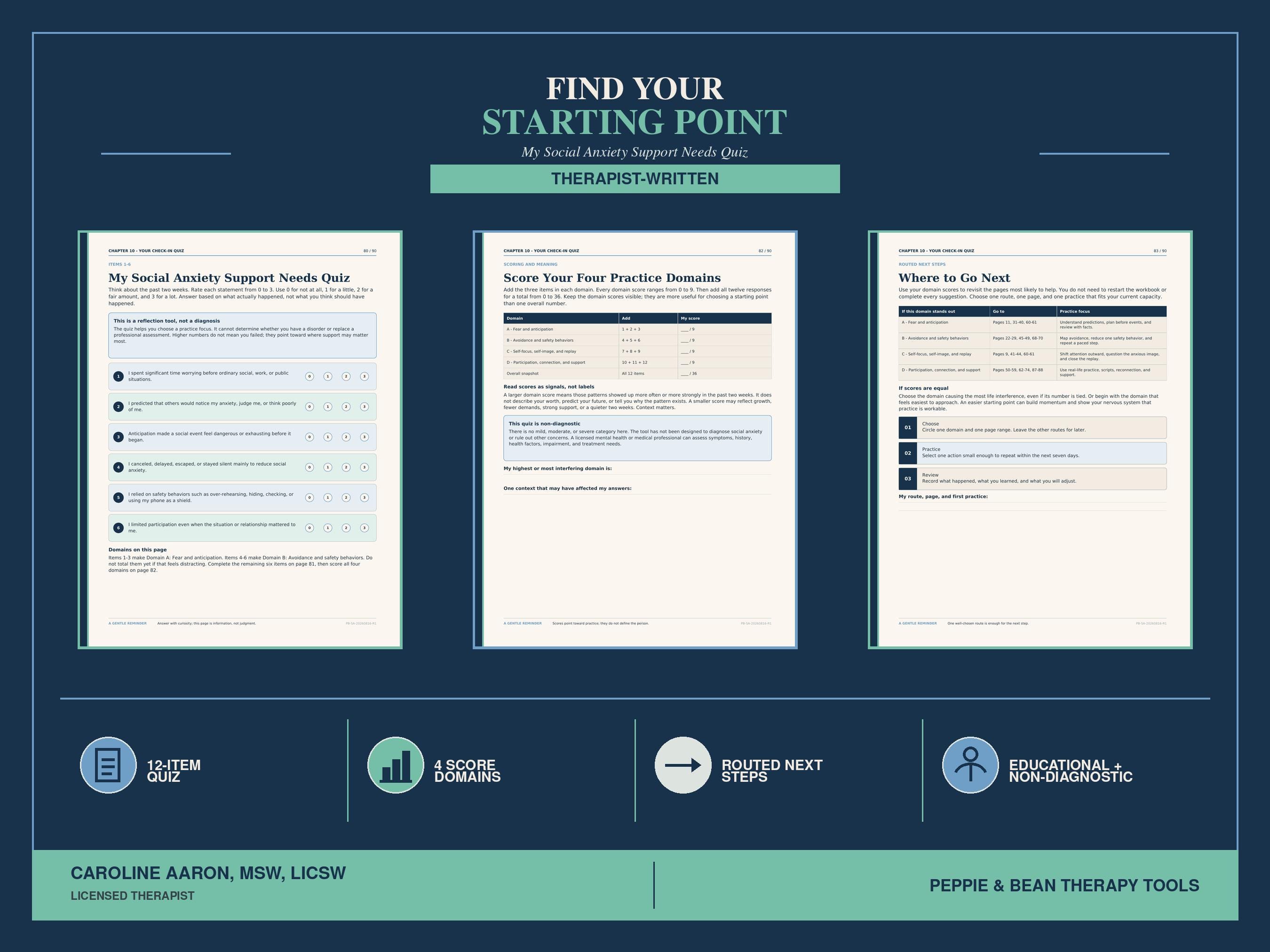
12-ITEM SOCIAL ANXIETY SUPPORT NEEDS QUIZ INCLUDED
The workbook includes My Social Anxiety Support Needs Quiz, an educational, non-diagnostic 12-item reflection quiz.
It looks at four areas:
* Fear + Anticipation
* Avoidance + Safety Behaviors
* Self-Focus + Replay
* Participation + Support
Rather than giving you one label, the quiz helps you see which part of the pattern may need the most support right now and choose a realistic place to begin.
REAL ADULT SITUATIONS
The workbook includes fictional and composite examples involving everyday adult situations such as:
* Meetings
* Work conversations
* Phone calls
* Appointments
* Dating
* Friendships
* Social gatherings
* Invitations
* Speaking up
* Joining conversations
* Asking questions
* Responding to awkward moments
* Returning after avoidance
Examples are clearly presented as fictional/composite teaching examples—not client stories.
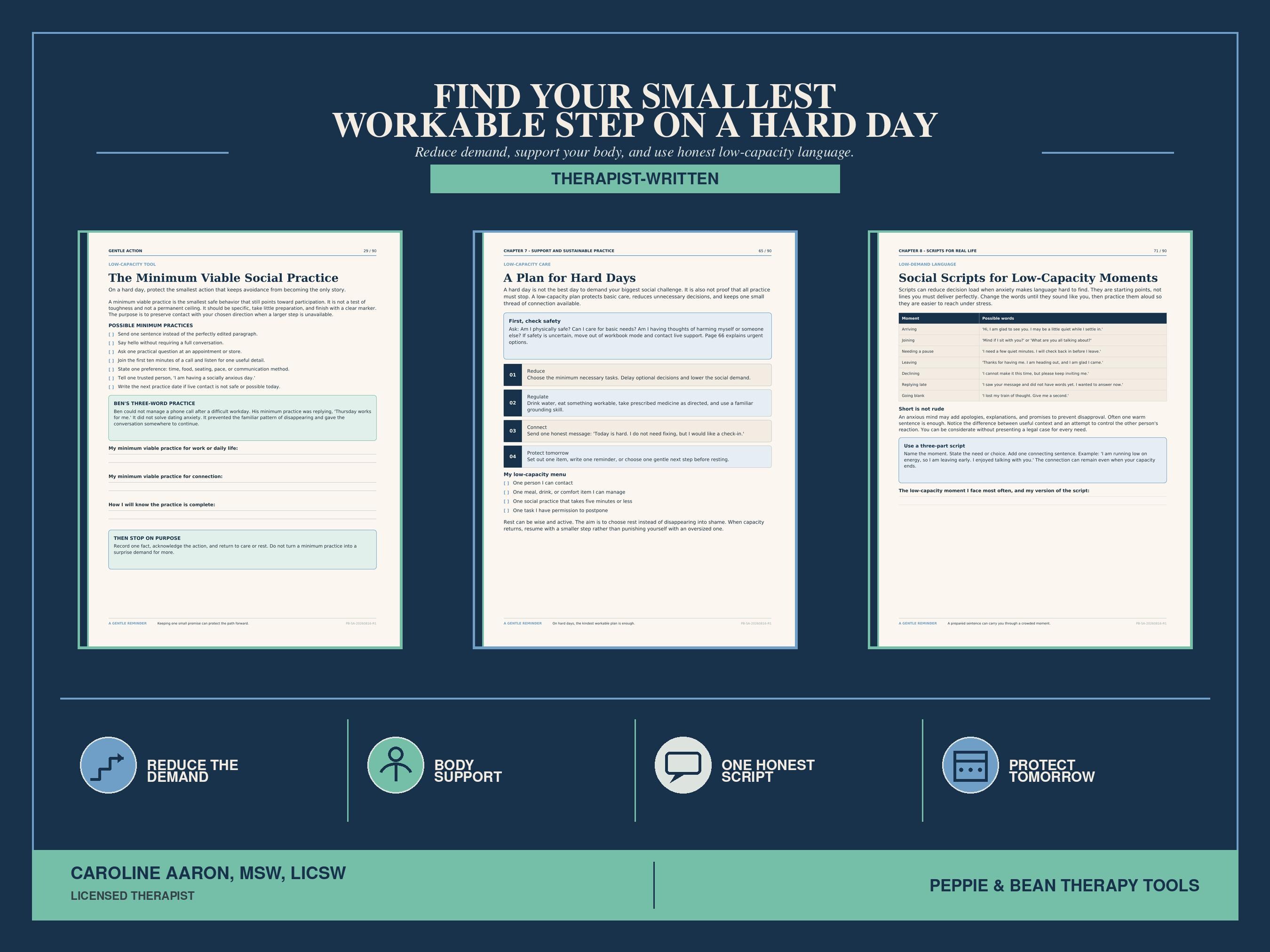
SUPPORT FOR HARD DAYS
Some days you may have enough capacity for a full worksheet.
Other days, even sending a text or walking into a room may feel like a lot.
The workbook includes a smaller-step Hard-Day Support Plan so a difficult day does not automatically become total withdrawal.
You are encouraged to work with your actual capacity—not punish yourself for not having more.
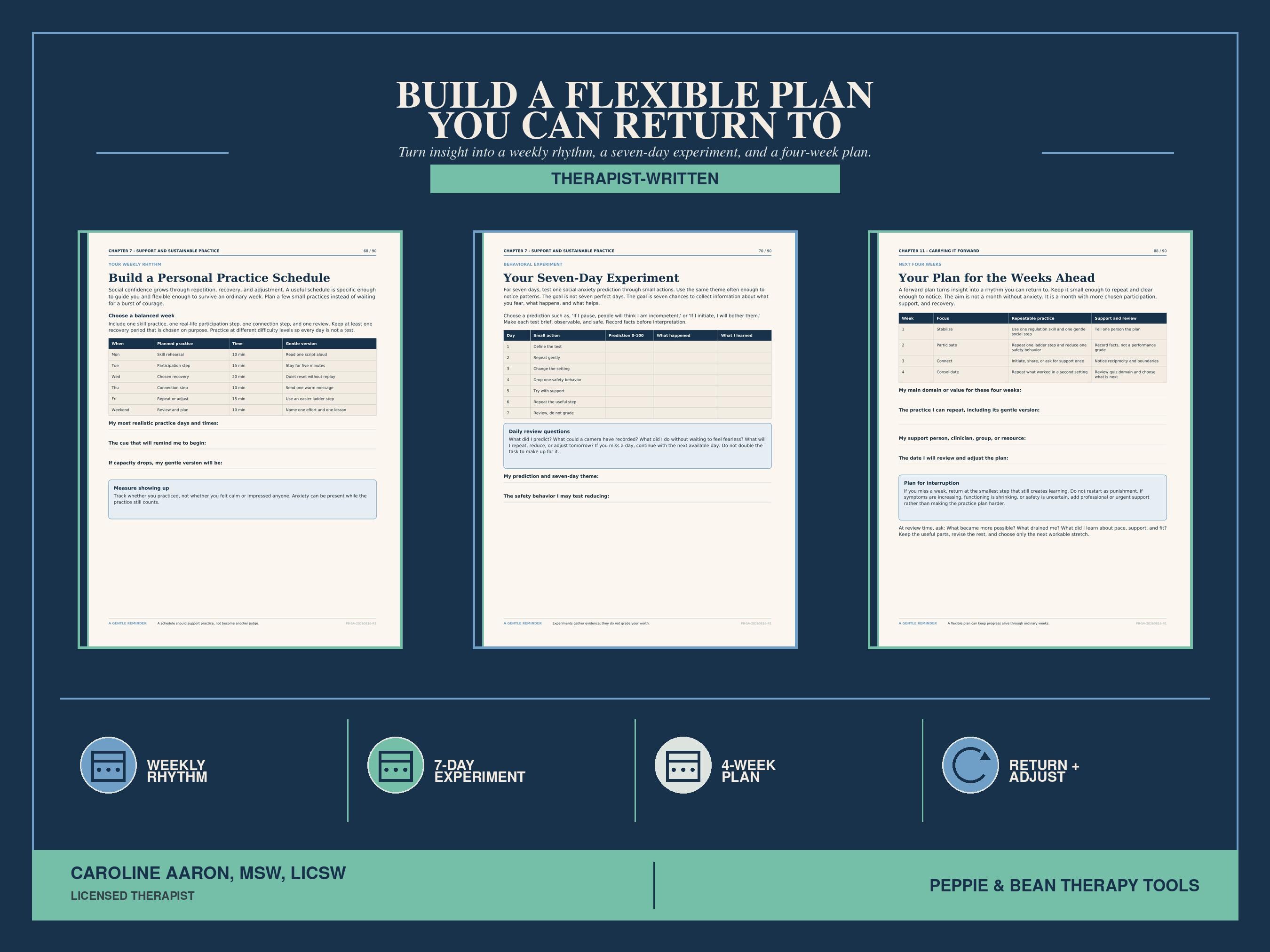
BUILD A PLAN YOU CAN RETURN TO
Toward the end of the workbook, you’ll gather what you’ve learned into a flexible personal plan.
You’ll identify:
* Your most familiar social-anxiety patterns
* Predictions you want to test
* Safety behaviors you may gradually loosen
* Repeatable social practices
* Smaller versions for difficult days
* Helpful scripts
* Support people and professional resources
* Ways to return after setbacks
The goal is not perfection.
Return instead of restart.
WHAT MAKES THIS WORKBOOK DIFFERENT
* Written specifically for adults
* Created by a licensed therapist
* 90 substantial pages
* Book + workbook format
* Clear psychoeducation before exercises
* CBT-informed tools
* Realistic fictional/composite examples
* Social-anxiety diagrams and pattern maps
* 12-item support-needs quiz
* Prediction-to-Outcome Map
* Hard-day options
* Practical adult examples
* Guided practice rather than blank journal pages
* Flexible continuation planning
* No pressure to become an extrovert
* No requirement to feel fearless before participating
WHAT YOU RECEIVE
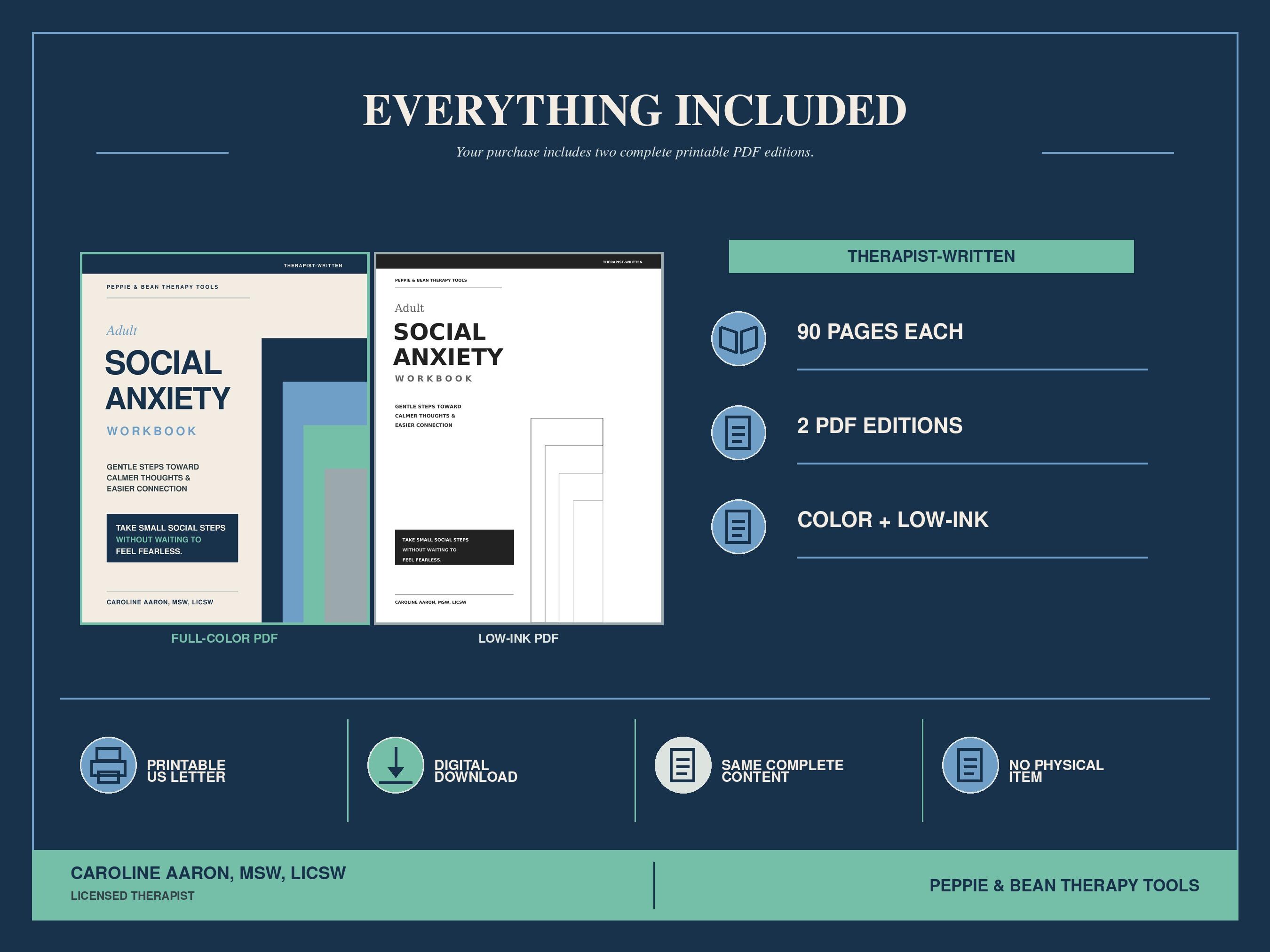
* 1 complete 90-page full-color PDF
* 1 complete 90-page purpose-designed low-ink PDF
* Same complete workbook content in both editions
* US Letter size: 8.5 × 11 inches
* Printable digital files
* Instant digital download
* No physical item will be shipped
Use the full-color edition for screen reading or color printing, and the low-ink edition when you want a more printer-friendly option.
Print the entire workbook or only the pages you want to use.
FOR INDIVIDUALS AND CLINICIANS
This workbook may be useful for adults working independently or alongside therapy.
A purchasing clinician may also print pages for direct one-to-one use with their own clients under the included individual clinician-use terms.
The files may not be resold, redistributed, uploaded to shared drives, supplied to other professionals, used in group programs, or commercially reproduced.
CREATED BY A LICENSED THERAPIST
Created by:
Caroline Aaron, MSW, LICSW
Licensed Therapist
Peppie & Bean Therapy Tools
With the help of Peppie & Bean, Therapy Dogs.
My goal is to make mental-health education feel clear, practical, compassionate, and usable in ordinary life.
Clear support. Realistic practice. No pressure to become someone else.
IMPORTANT NOTE
This workbook is an educational self-help and guided-reflection resource. It is not psychotherapy, diagnosis, medical care, crisis care, or a substitute for individualized treatment from a qualified professional. Purchasing or using this resource does not establish a therapist-client relationship.
This is a digital product. No physical workbook will be mailed.
Digital downloads
Your files will be available to download once payment is confirmed.
0 items in your cart